

By Helga Sommer, P.E. and Erik Stromberg
Every port executive has experienced the same conversation. Engineering recommends rehabilitating an aging berth. Operations believes expanding a container yard should take priority. Maintenance reports that electrical systems are becoming increasingly unreliable. Finance reminds everyone that only one or two major projects can be funded this year.
Every port executive has experienced the same conversation. Engineering recommends rehabilitating an aging berth. Operations believes expanding a container yard should take priority. Maintenance reports that electrical systems are becoming increasingly unreliable. Finance reminds everyone that only one or two major projects can be funded this year.Each proposal has merit but only one can move forward. This is where Asset Management delivers its greatest value to the organisation. Asset Management is often associated with maintenance. In reality, its greatest contribution is helping organisations make better investment decisions. It provides a structured way to decide where limited capital will create the greatest long-term value. For most ports, including those in the Caribbean, this challenge grows continuously. Infrastructure is ageing. Customer expectations are increasing. Climate resilience has become a strategic priority. At the same time, funding remains constrained. Every investment made today means another investment must wait. This makes good decision-making more important than ever.
Start with the port’s mission Effective Asset Management does not begin with an inspection report. It begins with the Port’s mission.Every capital project should support the organisation’s strategic objectives. Those objectives may include increasing cargo throughput; expanding cruise capacity; improving resilience; reducing operating costs; or, enhancing customer service. Without a clear understanding of those priorities, investment decisions can become reactive rather than strategic. This is why the Strategic Asset Management Plan (SAMP) is so important.The SAMP connects the Port’s strategic vision with its physical assets. It provides a framework for deciding not only what should be invested in, but when and why. A successful SAMP should not be developed solely by engineers. Operations understands how assets are used every day. Maintenance understands where failures occur most often. Finance understands funding constraints. Commercial staff understand customer expectations. Executive leadership establishes organisational priorities. When these perspectives come together, investment decisions become more balanced and more defensible.The SAMP should also remain a living document. Ports evolve. Trade patterns change. Technology advances. New regulations emerge. A plan developed five years ago may no longer reflect today’s priorities. Reviewing the SAMP alongside the annual capital budgeting process helps to ensure that investment decisions remain aligned with the Port’s current strategic direction.
Not every asset is equally important Ports own thousands of assets … wharves, buildings, roadways, electrical systems, stormwater infrastructure, utilities, cargo equipment, information technology systems … to name but a few. Each asset contributes differently to the Port’s mission. A deteriorated warehouse roof could inconvenience operations. Failure of a cruise berth during peak season could disrupt thousands of passengers, multiple cruise lines and the local economy. Although assets require maintenance, they should not compete equally for limited capital funding. Asset Management recognizes this difference. Condition alone should never determine investment priority. An asset may be in poor condition but have little operational importance. Conversely, an asset in relatively good condition may be so critical that even a small increase in the risk of failure warrants immediate investment. Good Asset Management considers both condition and consequence.
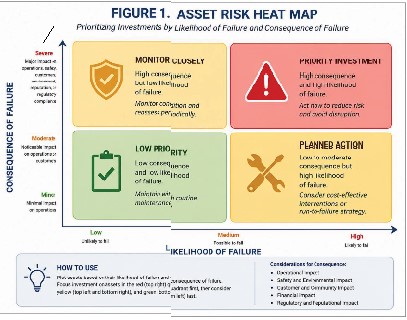
Turning risk into better decisions One of the most useful tools is the asset risk heat map. While one axis measures the likelihood of failure of a given asset, the other measures the consequence of that failure. Placement of key assets in the four quadrants of the heat map can facilitate discussion and aid decision-making. For example, assets with a high probability of failure and severe operational consequences, such as a key berth, move to the top of the investment list. Assets presenting lower risk and minimal impact can often remain in service with routine maintenance or targeted repairs. High-value, low-failure-risk assets should be carefully monitored. Finally, for assets with a strong likelihood of failure but low operational consequence, running the asset to failure may be an appropriate strategy. The heat map does not make decisions. People do. However, it provides a transparent and repeatable framework for comparing different major maintenance investment options. That transparency becomes especially important when explaining these decisions to governing boards, funding agencies, or the public.
Rarely only one solution As discussed above, replacing an asset is not always the best answer. Sometimes rehabilitation offers better value.Sometimes a component can be upgraded rather than replacing the entire asset. Occasionally, an asset can be repurposed to support a different operational need. In other cases, allowing an asset to operate until failure may be an acceptable business decision if the operational consequences are limited. Each option has different costs, risks, and operational impacts. Asset management encourages organisation to evaluate those alternatives before committing to major capital expenditure. The goal is to spend available money more wisely.
Practical lessons from PortMiami At PortMiami, one of the most valuable lessons has been that Asset Management is fundamentally about collaboration.· Engineering alone cannot determine investment priorities.· Operations may identify challenges that are not visible in inspection reports.· Maintenance often recognizes recurring reliability problems before they appear in condition assessments.· Finance understands long-term affordability.·
Executive leadership balances organisational priorities with available resources.Bringing these five perspectives together consistently leads to better decision-making.Another important lesson is that priorities change. Several years ago, resilience projects accounted for a relatively small share of the capital programme. Today, they have become central to many investment discussions. Similarly, increasing vessel sizes, evolving cargo markets, and changing cruise industry expectations continue to influence how infrastructure investments are prioritised.A good Asset Management programme provides enough flexibility to respond to these changing priorities without losing sight of long-term organisational objectives. PortMiami has also learned that perfect information should not become the enemy of good decision-making. Every organisation would like complete inspection data, detailed deterioration models and precise life-cycle costs for every asset. Very few have them. Waiting until every uncertainty has been eliminated often delays important decisions. Instead, successful organisations use the best information available while continually improving its quality over time. Progress matters more than perfection.
Data supports decisionsTechnology is transforming Asset Management – Digital twins, Enterprise Asset Management systems, Geographic Information Systems, Drones, Mobile inspections, Predictive analytics. These tools provide better information than we have had. Technology, however, is not the objective. Good decisions still depend on professional judgement, operational experience and organisational priorities. Technology supports those conversations. It does not replace them.
Continuous improvement Asset Management is not a project that ends. It is a process driven by management philosophy. Ports continually change. Infrastructure ages. Customer expectations evolve. Budgets fluctuate. Every investment creates an opportunity to learn.· Did rehabilitation achieve the expected service life?· Were maintenance costs reduced?· Did reliability improve?· Were operational disruptions minimized?Answers to these questions should influence future investment decisions. International standards, such as the ISO 55000 series, recognize this philosophy. Rather than prescribing a single process, the standards provide a flexible framework that organisation can adapt to their own operating environment, asset portfolios, funding sources and strategic priorities. The objective is to establish a continuous improvement process.
Measure of success A successful Asset Management programme will increase the predictability of the Port’s key assets’ performance. It will lead to fewer unanticipated failures. Major maintenance will be done with confidence, directed to where it is most needed and important and that process will endure through personnel changes.Capital budgets can be formulated, especially in the out years, with greater certainty about life cycles of key assets. While building a culture of Asset Management within the organisation can be tedious, it can deliver positive and long-lasting change in the way a Port operates.