
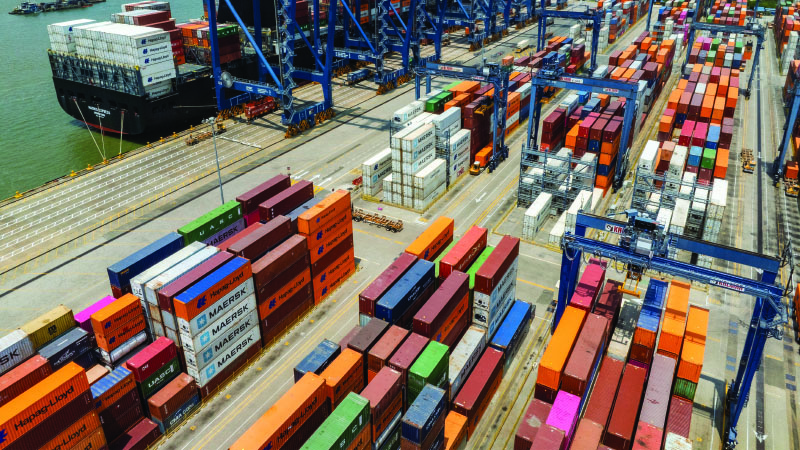
In just over three decades since incorporation and privatisation in 1993, the grand port at Cartagena in Colombia has evolved to be one of the Caribbean’s leading container and trans-shipment hubs, moving more than four million TEU last year (2025).
Formerly a relatively small regional gateway handling just about 93,000 TEU yearly, the Group Port of Cartagena, which comprises Sociedad Portuaria Regional de Cartagena (SPRC, Manga Terminal) and Contecar, is now one of the Caribbean region’s most impressive multi-terminal port systems. In just over
30 years, the group has combined network connectivity, terminal productivity and infrastructure development to fuel growth and expansion and to support Colombia’s economic development.
Cartagena currently maintains service links to more than 820 ports across 120 countries through global liner services, supporting both gateway and relay cargo. Its geographic position and terminal performance have made it increasingly relevant for trans-shipment distribution across the Caribbean Basin, as well as north-south and east-west trades.
“Growth has been driven by phased terminal expansion, liner network integration, and sustained upgrades in nautical access and equipment,” said Giovanni Benedetti, senior executive and now in his 30th year as Chief Commercial Officer at the Group Port of Cartagena. “Port development in Cartagena has become closely tied to national and regional outcomes, enabling trade, supporting supply chains, creating formal employment, and helping to ensure the steady movement of food, pharmaceuticals, industrial inputs and export cargoes. All this supports Colombia’s economic stability and rising living standards.”
As regards network connectivity and alliance positioning, Benedetti explained: “For exporters and importers, that connectivity translates into shorter transit times, more routing options, and greater reliability – factors that directly affect business competitiveness and consumer access to goods.
“The port’s hub profile strengthened further with its selection last year (2025) as one of 14 global hubs in the Gemini Cooperation network (formed by Maersk and Hapag-Lloyd). The alliance’s hub-and-spoke model prioritises ports that are capable of high berth productivity, schedule integrity, and nautical accessibility, with reliability targets of more than 90%.”
Inclusion in these networks benefits the local economy in that they secure long-term vessel calls; create logistics activity and benefit local service industries, he noted.
Infrastructure scale, nautical access
Cartagena has effectively sustained its global stature as an efficient and dependable hub over decades, providing the infrastructure, systems and services demanded by client users. Growth, upgrading and terminal expansion at Group Port of Cartagena has been constant and in step with global trends. Terminal expansion therefore reflects current vessel upsizing and network consolidation trends.
DRAFT: Maximum drafts are 16.5 metres at Contecar, and 15.5 metres at SPRC, accommodating container ships of up to 18,000 TEU capacity (approx.).
SPACE: The combined terminal area now totals approximately 140 hectares, including about 40 hectares at SPRC and 100 hectares at Contecar. Total berth length now exceeds 2,000 metres across the two facilities. Current yearly throughput capacity across the complex is about five million TEU. Contecar has expanded its logistics footprint with more than 60,000 square metres of warehouse space, refrigerated cross-dock facilities and, value-added logistics services aimed at consolidation and regional distribution.
MACHINES: The quay crane fleet includes 19 Super Post-Panamax units supported by modern yard handling equipment configured for high trans-shipment density. These capabilities support not only global carriers, but also regional producers and distributors seeking faster, more flexible supply chain solutions.
Performance metrics; operational efficiency
Performance gains have been attributed to a combination of yard process redesign, equipment density, berth planning discipline, digital operating systems, workforce experience and operational culture. In this regard, the effectiveness and reliability of the port at Cartagena have drawn the attention and acknowledgement of the global shipping community.
As Benedetti noted, Cartagena has been ranked among the top-performing ports globally in berth productivity and vessel turnaround metrics. In the World Bank–S&P Global Port Performance Index for 2024, the Cartagena port complex placed third for its time-in-port indicators and operational efficiency benchmarks.
“Cartagena has also received repeated recognition from the Caribbean Shipping Association, having been judged Best Port in the Caribbean on 10 occasions.
This highlights our service consistency as regards larger average vessel sizes and tighter schedule windows.”
Technology, people, service reliability
Digitalisation programmes have focused on terminal operating systems, cargo traceability, gate automation and yard orchestration tools designed to reduce transaction friction and dwell times. Benedetti observed that data-driven planning and real-time visibility have improved for both trans-shipment and gateway cargo but that technology is only part of the performance equation.
“Productivity gains depend on trained teams, safety culture and, operational discipline. Continuous investment in workforce training, safety standards, and leadership development has supported the port’s labour stability and service reliability… this in a sector where disruption risks can quickly ripple across supply chains. In this regard, a sustained people-centred workplace strategy has earned us repeated Great Place to Work recognition, linking employee well-being with operational consistency and customer outcomes.
“In this regard, workforce diversification has increased steadily, with higher female participation across administrative, technical, operational, and management roles – a notable shift in a historically male-dominated segment of the logistics industry. In 2025, both terminals were recognised by Great Place to Work among the top-ranked employers of women. Our management views diversity and inclusion as operational strengths tied to innovation, adaptability and decision-making quality – not only social commitments.”
Outlook: capacity, digitalisation, sustainability
The Group Port of Cartagena has firm plans for increasing capacity and productivity upgrades in 2026 to 2027. These development initiatives are aimed at supporting trade growth and accommodating larger vessels. In this regard investment in automation and digital systems will continue.
“Sustainability initiatives, including energy efficiency measures and emissions-reduction programmes, aligned with maritime sector decarbonisation targets, will be integral to our development plans. Increasingly, environment protection is being regarded as a competitive factor in port selection by both carrier and cargo owners.
“As liner strategies continue to favour fewer, higher-performing relay hubs, Cartagena’s connectivity profile, infrastructure depth and productivity metrics position it to remain a primary trans-shipment platform for the Caribbean and the wider Americas. Port leadership frames the next phase not only in terms of volume and efficiency, but also impact – serving economies, creating wealth, enabling trade, and contributing to better living conditions in the communities connected to the port’s activity.”